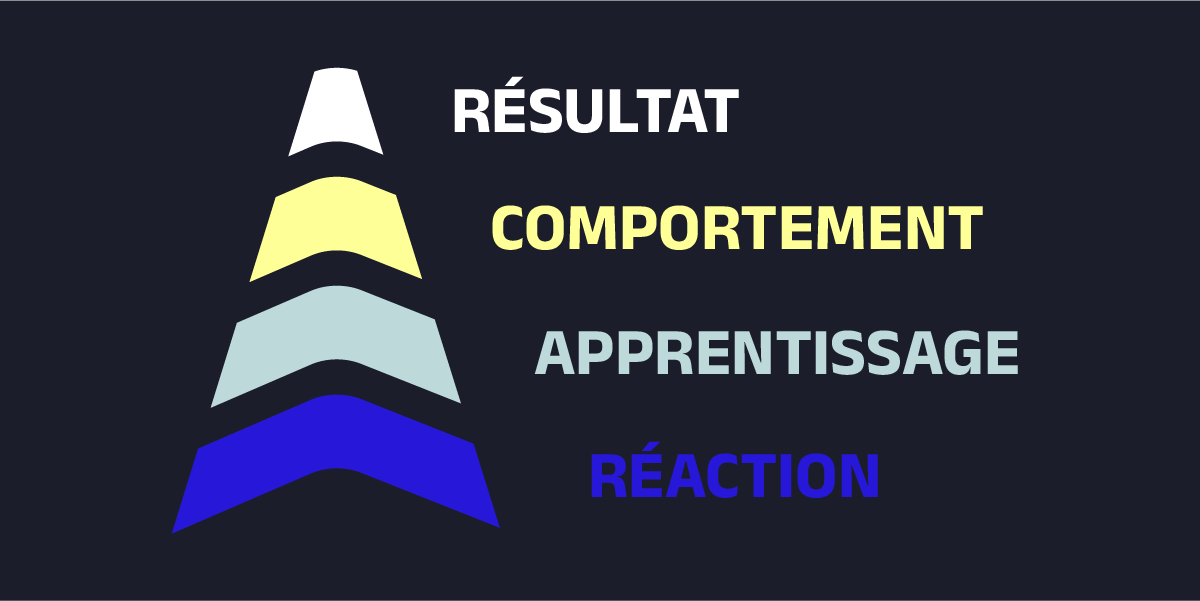
Developed in the 1950s and enhanced since 2010, the Kirkpatrick model is today one of the most widely used training evaluation methods in organisations. Its principle: measuring the impact of training through four progressive levels, from the immediate reaction of participants through to concrete results on business performance. Valued by HR teams and training directors for its rigour and versatility, it applies to all types of programme: face-to-face, remote or blended.
The Kirkpatrick Model: Origins and Evolution
Understanding how this model has evolved makes it possible to grasp its full current relevance and to avoid an outdated reading of its principles.
An Evaluation Framework Developed in the 1950s
The Kirkpatrick model was created by Donald L. Kirkpatrick in the 1950s. It offers a structured methodology for evaluating the value and impact of professional training programmes. By understanding and applying its principles, organisations improve their capacity to train their staff and develop the skills of their teams, whilst aligning their training actions with their strategic objectives. The model also allows employees to demonstrate their commitment to the success of the organisation, by making the progress achieved visible.
The New Model Since 2010: What Has Changed
Since 2010, the model has evolved to cover dimensions that the original version did not incorporate. Level one is no longer limited to measuring satisfaction: it also assesses the relevance of the training to the employee's real working situations, as well as their level of engagement. Level two goes beyond the simple acquisition of knowledge to also measure attitude, confidence and commitment to putting new skills into practice. Level three now recommends establishing mechanisms to ensure that behavioural changes actually occur, through monitoring and recognition systems. Level four introduces the concept of ROE, or Return on Expectations: the expectations of the decision-makers who commissioned the training must be defined in advance for this level to be accurately assessed.
The Four Levels of Evaluation in the Kirkpatrick Model
The four levels form the heart of the model. Each measures a different dimension of training effectiveness, in a progressive order that moves from perception towards impact.
Level 1: Reaction
The aim of this first level is to understand participants' opinions about the training they have attended. According to Kirkpatrick, effective training should generate positive reactions. If it does not, there is a risk of affecting participants' motivation and compromising the sustainability of the programme. This evaluation is generally conducted using feedback forms in which participants express their level of satisfaction and their perception of the relevance of the training to their real working situations.
Level 2: Learning
This level measures the learning gained from the training: knowledge, skills and attitudes, in line with the objectives defined in advance. The updated model adds the measurement of participants' confidence and commitment to putting what they have learned into practice. This evaluation is critical: no behavioural change can occur if participants have learned little or nothing. It is conducted using performance tests or targeted assessments.
Level 3: Behaviour
This level evaluates changes in the employee's behaviour in their day-to-day professional activity, that is, the extent to which the newly acquired skills are effectively put into practice. The evaluation takes place in normal working conditions, making it a particularly valuable indicator of the concrete application of learning. The model recommends establishing monitoring and recognition mechanisms to encourage these behavioural changes over the long term.
Level 4: Results
This final level focuses on the concrete and quantifiable effects of the training on the organisation. The indicators assessed may include: increases in production or the quality of work produced, reductions in production costs, a fall in the number of accidents, or increases in profit or turnover. Since the model's update, this level is also where ROE (Return on Expectations) is measured: has the training met the expectations defined at the outset by the decision-makers?
Implementing the Kirkpatrick Model in Organisations
Knowing the four levels is one thing. Deploying them strategically in real professional contexts is another.
Starting With Level 4: A Reverse Approach
According to human resources specialists, effective deployment of the Kirkpatrick model begins at level four and proceeds in reverse. This approach involves first defining the expected results and the expectations of decision-makers, then determining the behaviours needed to achieve them, before building the pedagogical framework. This inverted logic ensures coherence between the organisation's strategic objectives and the content of the training programmes deployed.
Application in the Context of AFEST
In the context of AFEST (work-based training), the Kirkpatrick model is a particularly well-suited tool. Since AFEST draws on real working situations, the four levels can be evaluated naturally and continuously, as close as possible to operational practices. This concrete application improves the return on investment of training programmes and strengthens the legitimacy of future initiatives in the eyes of decision-makers.